
How to choose a gate
Garden, side, driveway or field? The right gate depends on what it’s for, the size of the opening and, above all, the posts it hangs on.
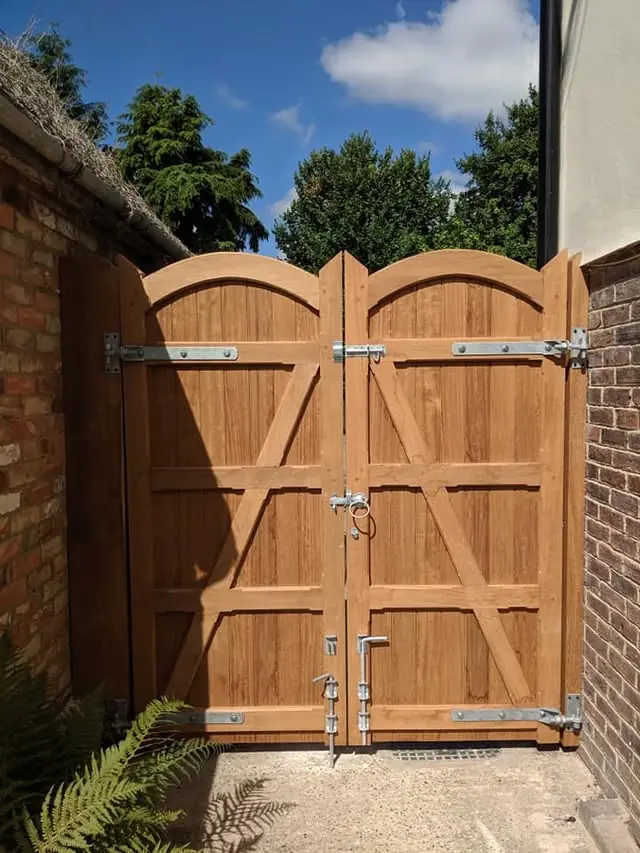
This is general guidance. Every opening is different, so we measure on site before we make or hang a gate.
Start with what it’s for
- Garden and side gates are about privacy and security at the side of the house. Closeboard, tongue & groove and palisade styles can be made to match the fence either side.
- Driveway gates need to be strong, hung on heavy posts and wide enough for the car with room to spare. Single or double leaf, depending on the opening.
- Field gates for paddocks and farms are usually five bar gates, in timber or galvanised steel.
- Security gates for schools, yards and sites should match the security fencing, otherwise the gate becomes the weak point.
- Kissing gates let walkers through on footpaths while keeping livestock in.
Measure twice
Measure the gap between the posts (or where the posts will go) at the top and the bottom, because old openings are often out of square. Then think about what has to fit through: wheelie bins, a mower, a wheelbarrow, a car. A gate that’s a little too narrow gets annoying very quickly.
Look at the ground too. If it slopes up in the direction the gate opens, the gate will catch. The fix might be a different opening direction, a raised gate or a double gate with shorter leaves.
The posts matter most
A gate is a lever. All its weight hangs off one post, and it gets pushed and slammed every day. That’s why gate posts should be heavier and set deeper than ordinary fence posts. Most sagging, dropped or sticking gates are really post problems, not gate problems.
Our timber posts are kiln dried, fully incised and treated to highway spec for ground contact. Read more about our timber.
Which way it opens
- Gates onto a pavement or road should open inwards, into the property.
- Check the swing doesn’t hit a step, a drain, a parked car or a plant pot.
- For wide openings, a pair of gates takes up less swing room than one big leaf.
Hinges, latches and bolts
Good ironmongery is a small part of the cost and makes a big difference. Use hinges rated for the weight of the gate, a latch that you can open from both sides if you need to, and a drop bolt to hold the second leaf of a double gate. On a side gate, a lockable bolt on the inside adds security.
Planning rules
Gates follow the same rules as fences and walls: usually no planning permission is needed up to 2 metres high, or 1 metre next to a road used by vehicles. Listed buildings, conservation areas and some newer estates have tighter rules. Our planning permission guide has more.
Quick answers
How wide should a garden gate be?
Wide enough for what has to go through it. A wheelbarrow, mower or wheelie bins usually need a wider gate than you’d think, so measure the bins or kit and allow a bit of room either side.
Should a gate open inwards or outwards?
Most garden and driveway gates open into the property, so they don’t swing over the pavement or road. Check the ground the gate will swing over, because a slope can stop it opening fully.
Timber or galvanised steel for a field gate?
Timber five bar gates have a traditional look that suits country properties. Galvanised steel gates are tough and need very little maintenance. We supply and hang both.
Do I need planning permission for a gate?
In England you don’t usually need planning permission for a gate up to 2 metres high, or up to 1 metre next to a road used by vehicles. Listed buildings, conservation areas and some newer estates have tighter rules. See our planning permission guide.